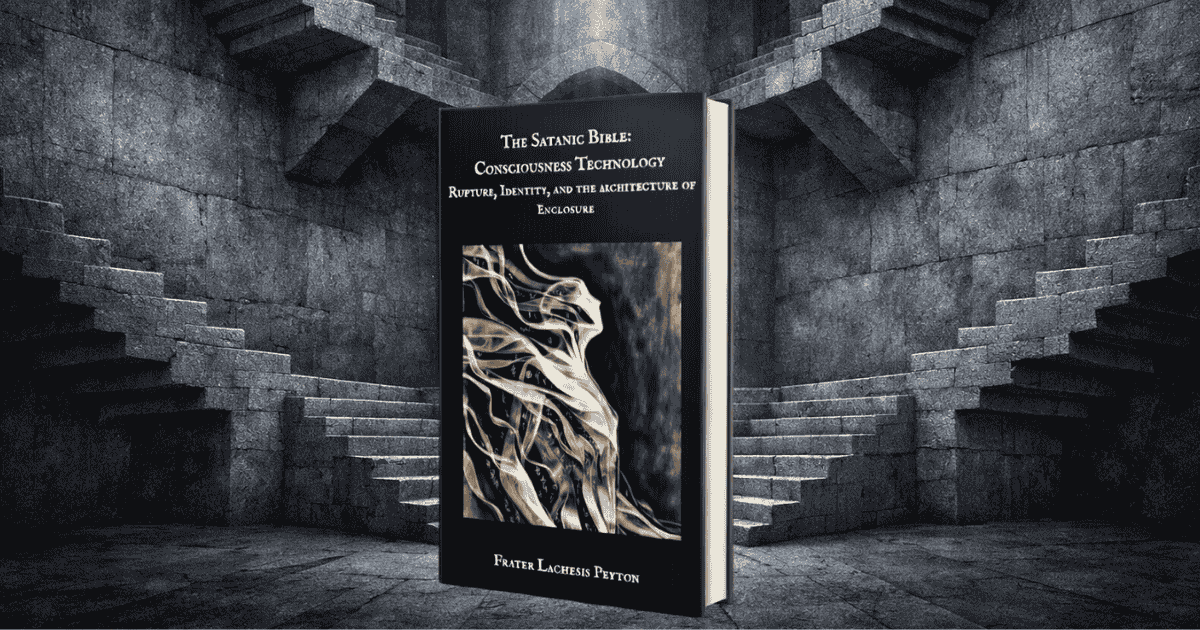
The Satanic Bible: Consciousness Technology: Rupture, Identity, and the Architecture of Enclosure: A Prison Interview
$16.99
This book examines The Satanic Bible not as theology to be embraced or dismissed, but as a functional system designed to produce specific psychological and social effects. Rather than asking whether Anton Szandor LaVey’s Satanism is true or false, this work asks a different question: what does it do?
Approached as a diagnostic monograph, the text analyzes The Satanic Bible as a form of consciousness technology—a structured set of rhetorical, symbolic, and ritual mechanisms that reorganize identity, belief, and will. Drawing on scholarship in the study of religion, psychology of identity, and critical social theory, the book traces how LaVey’s system succeeds powerfully at rupture, dismantling inherited guilt, external authority, and moral submission, while simultaneously installing a subtler architecture of enclosure.
Each section of The Satanic Bible is examined in turn. The Nine Satanic Statements are treated as threshold devices that grant permission and reframe desire. The Book of Satan is analyzed as shock technology engineered to fracture internalized authority through sustained inversion and contempt. The Book of Lucifer is read as applied social engineering, translating rupture into tactical manipulation and identity consolidation. The Books of Belial and Leviathan are examined as ritual technologies that intensify will and affect while offering no mechanisms for integration or release.
The central argument is developmental rather than moral. Systems built for rupture function effectively under specific conditions, particularly for individuals emerging from coercive religious or moral environments. Problems arise when rupture hardens into identity and opposition becomes permanent posture. Drawing on developmental psychology, Vedantic diagnostic models, phenomenology, and comparative esotericism, the book shows how liberation technologies quietly reproduce the very captivity they claim to destroy.
The latter sections move beyond critique without offering a replacement belief system. Instead, they introduce structural lenses—observer consciousness, symbolic containment, phenomenological mapping, and integration criteria—that allow readers to recognize when a system has completed its useful phase. The work does not prescribe new doctrines or practices. It provides language for seeing where power ends and enclosure begins.
Written for scholars of new religious movements, practitioners and former practitioners of Satanic and left-hand path systems,
Description
This book examines The Satanic Bible not as theology to be embraced or dismissed, but as a functional system designed to produce specific psychological and social effects. Rather than asking whether Anton Szandor LaVey’s Satanism is true or false, this work asks a different question: what does it do?
Approached as a diagnostic monograph, the text analyzes The Satanic Bible as a form of consciousness technology—a structured set of rhetorical, symbolic, and ritual mechanisms that reorganize identity, belief, and will. Drawing on scholarship in the study of religion, psychology of identity, and critical social theory, the book traces how LaVey’s system succeeds powerfully at rupture, dismantling inherited guilt, external authority, and moral submission, while simultaneously installing a subtler architecture of enclosure.
Each section of The Satanic Bible is examined in turn. The Nine Satanic Statements are treated as threshold devices that grant permission and reframe desire. The Book of Satan is analyzed as shock technology engineered to fracture internalized authority through sustained inversion and contempt. The Book of Lucifer is read as applied social engineering, translating rupture into tactical manipulation and identity consolidation. The Books of Belial and Leviathan are examined as ritual technologies that intensify will and affect while offering no mechanisms for integration or release.
The central argument is developmental rather than moral. Systems built for rupture function effectively under specific conditions, particularly for individuals emerging from coercive religious or moral environments. Problems arise when rupture hardens into identity and opposition becomes permanent posture. Drawing on developmental psychology, Vedantic diagnostic models, phenomenology, and comparative esotericism, the book shows how liberation technologies quietly reproduce the very captivity they claim to destroy.
The latter sections move beyond critique without offering a replacement belief system. Instead, they introduce structural lenses—observer consciousness, symbolic containment, phenomenological mapping, and integration criteria—that allow readers to recognize when a system has completed its useful phase. The work does not prescribe new doctrines or practices. It provides language for seeing where power ends and enclosure begins.
Written for scholars of new religious movements, practitioners and former practitioners of Satanic and left-hand path systems,
Additional information
| Weight | .9 lbs |
|---|---|
| Dimensions | 9 × 6 in |